

Photo & Story by Arun Dhruv
Parambikulam Tiger Reserve is one of the most pristine protected forests in the Western Ghats. Known for its rich biodiversity, dense tropical forests, and thriving wildlife population, it is a dream destination for wildlife photographers and nature lovers.
During a recent visit to Parambikulam, I had the opportunity to experience one of the reserve’s guided trekking programs. What started as a simple forest trek soon turned into an unforgettable wildlife encounter and a memorable photography moment.
Trekking Through the Bear Path Trail
For my visit, I chose the Bear Path trekking trail, one of the official trekking routes offered by Parambikulam Tiger Reserve.
All trekking activities inside the reserve are organized and regulated by the forest department. Visitors are not allowed to enter the forest on their own. Every trek must be accompanied by trained guides or naturalists who are familiar with the terrain and wildlife behaviour.
Interestingly, I was the only visitor who had booked the trek that morning. Since the trekking activity required a minimum group size, I had to pay the fee for four people in order for the trek to proceed.
Although it felt unusual at first, it turned out to be a unique experience. Instead of a crowded group trek, it became a quiet and personal walk into the forest with only a guide and the sounds of nature around us.
Walking Inside the Forest
Trekking in Parambikulam feels very different from regular hiking trails. The forest here is dense and layered with towering trees, bamboo clusters, and thick vegetation.
The reserve is home to an incredible variety of wildlife including elephants, gaur, sloth bears, sambar deer, and even the elusive tiger. Birdlife is also abundant, making the forest an excellent destination for wildlife photography.
The guide who accompanied me during the trek was extremely knowledgeable and experienced. He knew the forest intimately and could easily identify movements, sounds, and signs of wildlife that most visitors would miss.
During our trek he helped me spot several birds and animals, pointing out distant calls and subtle movements high in the trees or deep inside the foliage. Thanks to his guidance, the entire trekking experience became not just a walk but a learning experience about the forest ecosystem.
A Quiet Wildlife Encounter
At one point during the trek, something moved quietly behind the dense green foliage.
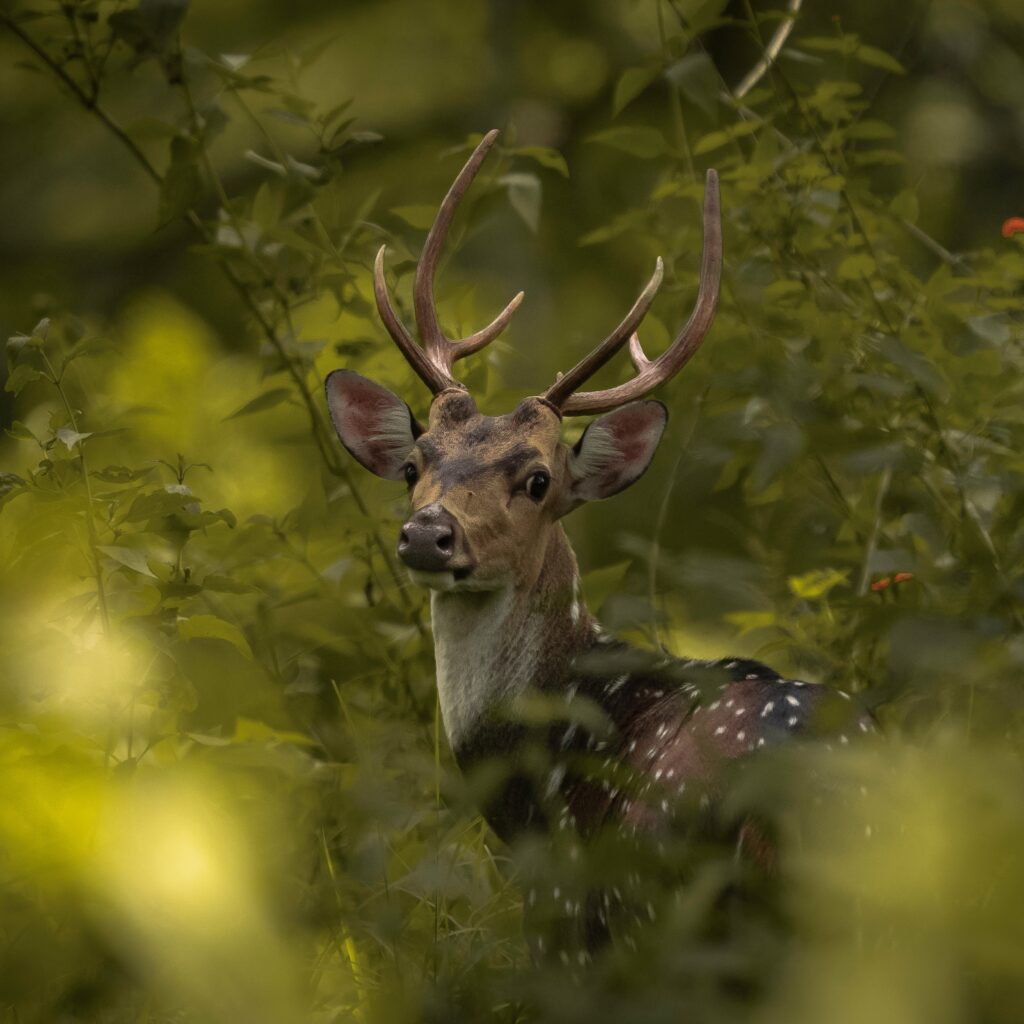
Through the leaves I noticed a beautiful Chital, commonly known as a spotted deer, standing calmly inside the forest.
Its antlers rose gracefully above its head while its alert eyes carefully observed the surroundings. The deer looked calm but cautious, fully aware of the forest environment around it.
The vegetation was quite dense, with leaves partially blocking the view. I had to carefully adjust my position and frame the shot through small natural gaps in the foliage.
For a few seconds the deer stood perfectly still, almost naturally framed by the surrounding greenery.
That brief moment was enough.
I managed to capture the photograph before the deer slowly moved deeper into the forest and disappeared into the vegetation.
Editing the Photo in Lightroom Mobile
After returning from the trek, I worked on the photograph using Adobe Lightroom Mobile.
Since the deer was surrounded by thick green foliage, I began by adjusting the exposure and shadows to bring out more details in the subject while maintaining the natural forest lighting.
I slightly reduced the highlights and increased the contrast to give the image more depth. The forests of Parambikulam naturally have rich green tones, so I carefully fine tuned the green hues and saturation to keep the colours vibrant yet realistic.
To make the deer stand out from the background, I added subtle clarity and texture to the subject while keeping the surrounding foliage slightly softer.
Finally, I balanced the tones and lowered the overall brightness slightly to create a natural moody forest atmosphere that reflects the feeling of standing inside a dense tropical jungle.
Wildlife Photography in Parambikulam Tiger Reserve
Parambikulam Tiger Reserve is considered one of the most important biodiversity regions in South India. The reserve forms part of the larger Western Ghats ecosystem, which is recognized as a global biodiversity hotspot.
Because the forest department carefully regulates tourism activities such as trekking and safari programs, the ecosystem remains well protected. This allows visitors to experience wildlife in a natural and undisturbed environment.
For photographers, Parambikulam offers incredible opportunities to capture birds, mammals, and forest landscapes.
However, wildlife photography here requires patience. Animals appear only when they choose to reveal themselves.
More Wildlife Photographs Coming Soon
During this trek along the Bear Path trail, I also managed to photograph several birds and other animals that we encountered along the way.
Thanks to the guide’s experience and sharp observation skills, spotting wildlife became much easier even in the dense forest.
I will be uploading more photographs from this trekking experience soon, including some of the birds and other animals we encountered during the walk.
Final Thoughts
Looking back at this photograph, what stays with me is not just the image of the deer but the entire experience.
Walking quietly through a living forest.
Listening to the sounds of nature around you.
And suddenly finding yourself face to face with a wild animal.
Moments like these remind us how extraordinary forests like Parambikulam truly are.
Sometimes the best wildlife photographs are not the ones we plan.
They are the ones that appear unexpectedly when we simply slow down, stay patient, and allow nature to reveal itself.